Learn how to cure ovarian cysts naturally without drugs , without risky surgery, without any typical ovarian cysts treatments, and without any side effects.
Ovarian cysts are small fluid-filled sacs which are usually not malignant(cancerous).These sacs may not cause any symptoms or they can cause quite a bit of pain .Sometimes ovarian cysts appear in connection with your menstrual cycle.
The pain can be excruciating. A sharp, yet dull throbbing sensation continuously occurring throughout the lower abdomen. You may feel as though you need to be rushed quickly to the hospital. You may wonder what is causing you to feel so bad or creating such an intense pain. If there has been no diagnosis, you may be experiencing the pain of an ovarian cyst or an ovarian cyst eruption.
What Are Ovarian Cysts?
Most females have ovarian cyst developing sometime during their life

Ovarian Cysts are fluid-filled sacs which are similar to blisters. Ovarian cysts are common among women during their reproductive years and are growths that form on the two almond sized organs on each side of the uterus. Most types of ovarian cysts are harmless and go away without any treatment.
Ovarian cysts are very common, particularly in women between the ages of 30 and 60. They may be single or multiple, and can occur in one or both ovaries. Most are benign (non-cancerous), but approximately 15 percent are malignant (cancerous).
Ovaries are feminine egg producing organs located on each side of the uterus.
Females are born with two ovaries. Ovaries are feminine egg producing organs located on each side of the uterus. The ovaries are about the size of an almond. Each month during a woman's childbearing years, an egg produced in the ovary is released. This release begins the monthly menstrual cycle. If during this period, the egg is fertilized, the result is most likely a pregnancy.
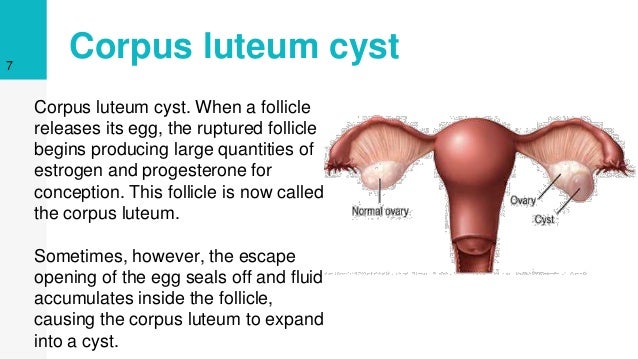
The normal function of the ovaries is to produce an egg each month. During the process of ovulation, a cyst-like structure called a follicle is formed inside the ovary. The mature follicle ruptures when an egg is released during ovulation. The corpus leteum forms from the empty follicle and if pregnancy does not occur, the corpus leteum dissolves. Sometimes this process does not conclude appropriately causing the most common type of ovarian cyst -- functional ovarian cysts.
Most females have ovarian cyst developing sometime during their life. Some cysts occur on a regular basis however will cause no discomfort. These cysts will usually disappear, burst or just dissolve without causing any further complications or discomfort. There are those times however, when the cyst will not burst or will burst causing excruciating pain.
Abnormal Ovarian Cysts such as:dermoid cysts,cystadenoma cysts,endometrioma cysts, and polycystic ovarian disease often occur as the result of an imbalance of female hormones (estrogen and progesterone).
A cyst lasting for an extended period may cause other problems. In all likelihood, your gynecologist will discover any abnormalities, including cyst, when performing the recommended yearly exam.
The normal function of the ovaries is to produce an egg each month. During the process of ovulation, a cyst-like structure called a follicle is formed inside the ovary. The mature follicle ruptures when an egg is released during ovulation. The corpus leteum forms from the empty follicle and if pregnancy does not occur, the corpus leteum dissolves. Sometimes this process does not conclude appropriately causing the most common type of ovarian cyst -- functional ovarian cysts.
Most females have ovarian cyst developing sometime during their life. Some cysts occur on a regular basis however will cause no discomfort. These cysts will usually disappear, burst or just dissolve without causing any further complications or discomfort. There are those times however, when the cyst will not burst or will burst causing excruciating pain.
Abnormal Ovarian Cysts such as:dermoid cysts,cystadenoma cysts,endometrioma cysts, and polycystic ovarian disease often occur as the result of an imbalance of female hormones (estrogen and progesterone).
A cyst lasting for an extended period may cause other problems. In all likelihood, your gynecologist will discover any abnormalities, including cyst, when performing the recommended yearly exam.
How Ovarian Cyst is Diagnosed?
For ovarian cyst it is important to have it accurately diagnosed, to distinguish it from other, more serious conditions like ovarian cancer.To diagnose a cyst, your doctor will do a Pelvic Exam and send you for an Ultrasound.
Pelvic Exam
To feel for masses or tenderness in your uterus or ovaries, your doctor will do a pelvic exam. The doctor will insert one or two fingers inside your vagina and press on your abdomen with the other hand.

In some cases, the doctor may also do a rectovaginal exam, where one finger is inserted into the rectum and one in the vagina,for just a few seconds, to feel for any lumps.
Your doctor will likely do these exams in conjunction with vaginal cultures and a Pap smear,to rule out infection and other causes of pelvic pain.
Ultrasound
An ultrasound directs high-frequency sound waves at organs inside the body - in this case, the uterus and ovaries.

The 'echoes' produce an onscreen image. Thicker tissue appears lighter on the ultrasound screen. Because cysts are filled with fluid, it is usually easy for a doctor to distinguish a cyst from a solid tumour when viewing the ultrasound pictures.
Ultrasound technology has been used for more than 35 years and studies show it is safe. It does NOT use radioactive material to produce an image.
Trans-vaginal ultrasound is used to diagnose ovarian cysts. A trans-vaginal ultrasound uses a slender wand, which is inserted into the vagina, to produce images of the uterus and ovaries on a video screen. The doctor then analyzes the images to determine whether there is a cyst. An ultrasound should not be painful, unless the cyst is already causing abdominal tenderness.